




Milling Cutters
Your Professional Milling Cutters Supplier
Kunshan Meiyaxing Hardware Machinery Co., Ltd. is a company specializing in the production and sales of metal cutting tools. With more than 20 years of experience, we set new technology, high-end machinery and tool manufacturers as one, to provide customers with quality tools, is a direct branch of Hong Kong Meiya International Trading company. Since the establishment of the company - always uphold the "quality", "professional" and "efficient" business philosophy. Founded the MANF brand, and with Japan Kyocera, Sumitomo, Mitsubishi, Taiwan ECHAIN, Germany C.P.T and other international brands trade cooperation.




Why Choose Us
Reliable Product Quality
We are proud of our high quality, cost-effective and good service, and have won the praise of customers in various industries such as aviation, medical equipment, automobile manufacturing, mold processing and electronic technology.
Good Service
High-quality after-sales service, tracking usage, and positive feedback. Rapid response within 24 hours.
Product Application
Our widely used in aviation, medical equipment, automobile manufacturing, mold processing and electronic technology and many other industries.
Technical Team
We not only provide high quality and efficient cutting tools, but also have a superb technical team to provide professional and detailed processing solutions.
Advantages of Milling Cutters
Superior Tool Life
High Feed cutters are purpose-built to tackle difficult-to-machine materials like stainless steels, titanium, and superalloys. Their design minimizes notched and built-up edges on inserts, extending tool life and reducing breakage.
Cost Efficiency
The four-sided solution allows for more material removal and makes your tooling budget go further. The environmentally friendly coating on the cutter body also contributes to longer tool life.
High Productivity
With a fine-tuned approach to cutting, High Feed cutters excel in everything from free-cutting austenitic stainless steels to cobalt and nickel-based superalloys. They achieve high per-tooth feed rates across their full depth of cut range, easily controlling chip formation to ensure fast and reliable processes.
Versatile Applications
Available in three sizes with a complete range of proven geometries and grades, these cutters are ideal for face milling, copy milling, ramping, pocketing, and plunging. Their positive, single-sided square approach ensures a constant lead angle up to the maximum depth of cut.
Types of Milling Cutters


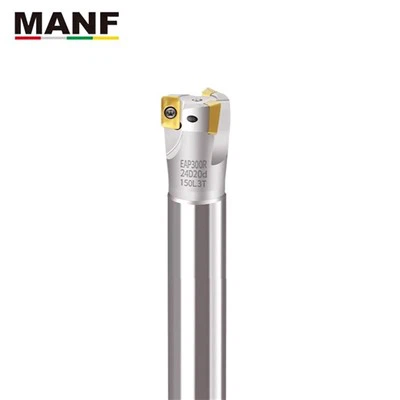
End Mill
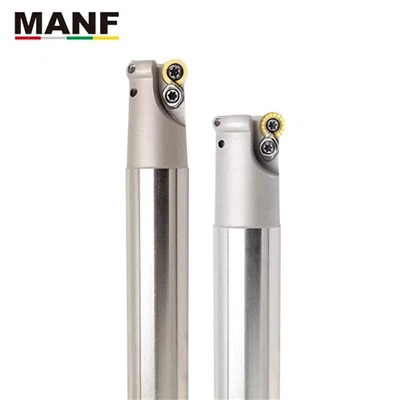
These tools usually have a flat bottom but not always. Round and radiused cutters are also available. End mills are similar to drills in the sense that they can cut axially. But the advantage for milling lies with the possibility of lateral cutting.
Face Mill
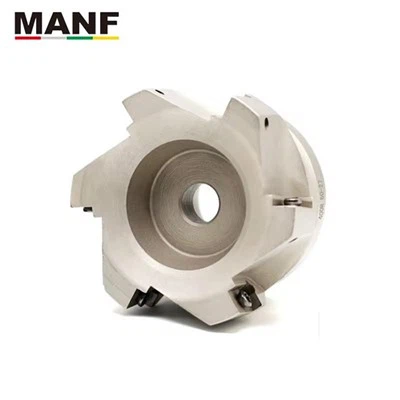
Face mills cannot cut axially. Instead, the cutting edges are always located on the sides of the cutting head. The cutting teeth are replaceable carbide inserts.
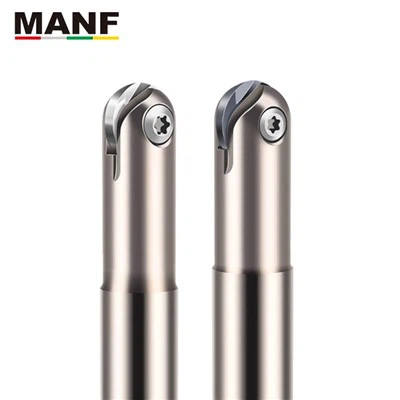
Ball Cutter
Ball cutters, also known as ball mills, have hemispherical cutting tips. The objective is to maintain a corner radius for perpendicular faces.
Slab Mill
Slab mills are not that common with modern CNC machining centres. Rather, they are still used with manual milling machines to quickly machine large surfaces. That is also why slab milling is often called surface milling.
Side-and-face Cutter
A predecessor for the end mill. Side-and-face cutters have teeth around the circumference as well as on one side. This makes the functionality very similar to end mills but their popularity has waned over the years with the advancement of other technologies.
Involute Gear Cutter
There is a special cutting tool for milling involute gears. There are different cutters available to produce gears within a certain number of teeth.
Fly Cutter
These tools have the same function as face mills. They consist of a central body that holds either one or two tool bits (double-end fly cutters).
Hollow Mill
Hollow mills are basically the opposite of face mills. Here, the workpiece is fed into the inner part of the mill to produce a cylindrical outcome.
Roughing End Mill
As the name says, these are pretty much end mills with a slight difference. The roughing end mill has jagged teeth. These make the cutting process faster than with a regular end mill.
Woodruff Cutter
Woodruff, or keyseat/keyway cutters are used to cut keyslots into parts, for example shafts. The cutting tools have teeth perpendicular to the outside diameter to produce suitable slots for woodruff keys.
Thread Mill
The name of this tool says everything you need to know about its purpose. Thread mills are used for producing tapped holes.
Materials of Milling Cutters
Carbon steel
The cheapest of the bunch. And this is exactly why it still finds use. As carbon steel is not very durable, it is only suitable for low-speed operations.
High-speed steel
High-speed steel, a grade of tool steels, has a few alloying elements added to it to provide better response to heat and wear than regular carbon steel. While the life cycle of such a tool goes up, so does the cost.
Cemented carbides
This material is harder than high-speed steel but the toughness qualities are not that impressive. The higher hardness provides better protection against wear but lower toughness levels make it a little more susceptible to cracking and chipping.
Cutting ceramic
Cutting ceramics are even harder than cemented carbides but lose in the toughness aspect. Both aluminium oxide and silicon nitride are used to produce these tools with varying properties.
Product Parameters
| MFWN90 Heavy Cutting Face Mill Cutter | |
| Brand | MANF |
| Name | MFWN Face Mill |
| Department List | MFWN90 Heavy Cutting Face Mill Cutter |
| Knife holder material | 42CrM0 |
| Hard consumption | 42`45° |
| Tool holder accuracy | 0.02 |
| Adaptable Insert | WNMU080608 |
| Suitable screws | M5*12/M5*14 |
| Wrench | T15 T20 |
| Number of blades | 4T, 5T,6T,7T,8T,9T,10T,12T,14T,16T |
Geometry of the Milling Cutter
Radial Rake Angle
The milling cutter's radial rake angle corresponds to the side rake of a single-point tool.
01
Axial Rake
Similarly, the axial rake angle of the cutter matches the back rake of a single-point tool.
02
Radial Relief
It involves the creation of a small angle to prevent the tool's interference with the workpiece during machining.
03
Axial Relief
In cases where the cutter's radius aligns along the face of the milling cutter, it is designated as having a zero rake.
04
Clearance Angle
This angle is formed between a line extending through the land's surface and a tangent drawn to the periphery at the cutting edge.
05
Precautions During Machining of Milling Cutters

Cutting Speed and Feed Rate
Choose appropriate cutting speed and feed rate based on the material and type of milling cutter to avoid excessive tool wear or poor surface quality.
Coolant Usage
For high-temperature materials or high cutting speeds, the use of coolant is crucial. It can effectively reduce the cutting temperature and extend tool life.
Tool Wear Inspection
Regularly check the wear condition of the milling cutter and replace it if necessary to ensure machining accuracy and surface quality.
Safety Operation
During milling, always wear proper protective equipment, such as safety glasses and gloves, to prevent injuries from flying chips.
About Transportation

FAQ